Wednesday, May 16, 2012

"Sarkozy, c'est fini!"


On the evening of May 6th, the long-awaited French presidential election results announced François Hollande as the next French president by a mere 3.8% over Sarkozy (51.9 to 48.1, according to Le Monde). The crowd of hundreds of thousands of Hollande supporters cheered and popped bottles of champagne around the Bastille as they waited for Hollande to make his first address as president.


I heard a report on NPR's Morning Edition that discussed France's election night, Hollande's plans for France, and the differences between Sarkozy's and Hollande's political platforms. One of the major differences that was highlighted in the news program (as well as in other popular media outlets) is their position on immigration and foreign affairs. While Hollande welcomes multiculturalism and more progressive approaches to strengthening France's international relationships, Sarkozy has always preferred more traditional and exclusionary tactics. Towards the end of the program there was a clip of the cheering crowd outside the Bastille when out of nowhere a voice comes to the forefront and shouts, "Vive la France! Vive les Marocains!". It made me reflect on how French politics affect Moroccan (and North African, more generally) society. What do Moroccans have invested in having their presidential candidate win office in France? Will France's relationship with Morocco change now that Hollande is president?


In late April, the French Embassy in Morocco published the results of the French elections in Morocco. There is a large portion of the urban population in Morocco that hold dual citizenship, which gives them the ability to vote in the French elections. In Rabat, François Hollande took the lead with 43.5% and Nicolas Sarkozy was the runner up with a mere 26.9%. The rest of the votes were divided among the remaining three candidates.

While the results differed depending on the city (Sarkozy won the majority vote in Marrakech for instance), what is undeniable is that the French elections were considered an important issue for Moroccans. Throughout the election cycle I had several conversations with my English language students about their opinions on the candidates, the French electoral process, and their hopes for the future of France. Most of my students are professionals who work for companies or organizations with strong European ties. Even if they don't think that the outcome of France's election will greatly affect aspects of their personal life, they all agree that it would change the way they do business with their French clients and partners.

From the students "polled", it was unanimously stated that they felt that Sarkozy was a disappointing president, and certainly not the type of president that France needs now. While some felt that Sarkozy's "work more, earn more" mantra did good things for the French economy, his eccentric personality made him difficult to trust his judgement in times of hardship. They believe that the French are ready to trade in their hot-shot celebrity president for someone more humanistic and moderate.

Furthermore, Sarkozy's strong anti-immigration and anti-multiculturalism stance weakened the country by dividing France into ethnic and cultural factions. He candidly identified certain groups as better than others, which led to a less united country. While he gained the support of the far-right through these actions, he lost the respect of everyone else. One student even said that Sarkozy was "France's George Bush": he managed to debase France's long history of high culture through his poor language and ignorant view point on immigration.

I see several paralells between Hollande's campaign and Obama's 2008 presidential campaign. The first similarity is in the type of candidate they are competing against. Sarkozy ran an incredibly conservative campaign whose foundation rested on the pillars of social conservativism and anti-multiculturalism. Ring any bells? The second similarity was in their progressive campaign slogans. Hollande's, "Le changement, c'est maintenant" (The change is now) begged for comparisons to Obama's 2008, "Change we can believe in" campaign slogan. Finally, the third similarity is in their voter demographic. While both Sarkozy and John McCain pushed for tighter immigration restrictions and paraded anti-multiculturalist values and bill proposals, both Hollande and Obama recognize the importance of the minority/immigrant vote. It will be interesting to see if these seemingly symbolic paralells seen between the two presidents' campaigns will manifest itself into anything significant as time progresses.


On a final note, I found out yesterday from one of my students that after the election results were announced, King Mohammed VI of Morocco coridally invited Nicolas Sarkozy to come to Morocco for a vacation. After François Hollande was officially sworn in yesterday as the President of the French Republic, Sarkozy boarded the King's private jet and set off to spend some time sunning himself at a resort in Marrakech. I asked my student if this gesture holds any greater political implications, since it seemed to me that the King still stands by Sarkozy. My student just shook his head and said, "No, I don't think so. The King did the same thing for Jacques Chirac."


Monday, May 7, 2012

A Saturday at Dar l'Kebira Orphanage


Throughout the semester, a common request we receive at the study abroad organization is to help students pursue volunteering in the Moroccan community, more specifically with the interest in doing work that would allow them to interact with Moroccan children. Together, a group of motivated students and I planned a cultural exchange/volunteering day at Dar l'Kebira that we called, "American Day". Dar l'Kebira is an orphanage/street children's association located in Kenitra, a mere 20 minute train ride from Rabat. It currently has about 40 children that live there, ranging anywhere from 6 to 16 years old.


We started the day with a tour of the facilities:


The lobby area. Behind the glass window is the arts and crafts room. During our visit, were told by staff members that usually the walls are filled with the children's art, however a lot of the artwork that students created was shipped to London for fundraising to benefit an international children's organization. 


An example of one of the girls' dormitory rooms. There are 8 children to each room.


The garden and sports field that we spent most of our day on.


The door leading into the kitchen and dining rooms.


After our tour, it was time to meet the children! We started by making name tags for everyone, helping the children write their names in English and Arabic script (and sometimes helping us!)...


...Others were more hesitant.


After name tags, it was playtime outside! We did a few games as a big group, some in darija and some in English. I was surprised by how many games had a Moroccan equivalent - duck duck goose, red light green light, monkey in the middle, and amoeba tag to name a few.


The games were not only a great way for the children to practice their English, but it was a fantastic opportunity for the students (myself included) to practice our darija! When a game requires you to recognize when your number in Arabic is selected, you better make sure you're staying attentive!


Time for dessert! We prepared an easy yet beloved dessert: dirt cups (chocolate pudding, cookie crumbles, and a few gummy worms), and the staff at Dar l'Kebira provided a lovely spread of cookies, chips, and chocolate. After having our sweet snack, the Moroccan children sang a few nursery rhymes to us and we reciprocated.


Despite the fact that we began the day with completely dfferent cultural and linguistic backgrounds, we spent the day laughing, running around, and enjoying one another's company. I was amazed just how strong of a connection everyone was able to make despite the language barriers. At the end of the day, nobody wanted to leave.


Special thanks to Aoife, our official "photo historian" of our day at Dar l'Kebira for capturing these moments on film!

Wednesday, May 2, 2012

Another side of Moroccan Culture: Gnaoua and the Layla Rituals

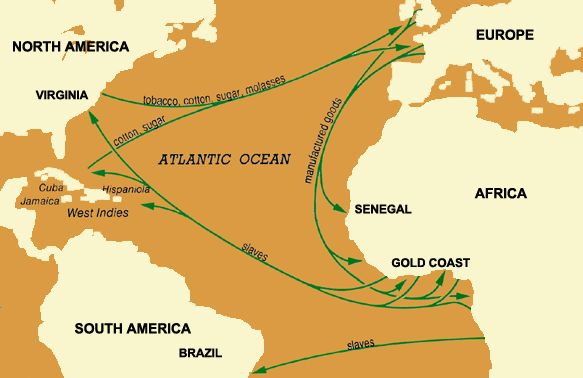
Gnaoua (ga-na-wa) is a musical and cultural tradition that comes out of the West African slave trade. The sleepy beach town of Essaouira in southern Morocco is known for its Gnaouan culture, which came about because it once was a major (slave) trade port on the Western coast of Africa. Today, Essaouira hosts a huge Gnaoua music and culture festival every June to honor its heritage. Many Western musicians such as Jimi Hendrix, Cat Stevens (now Youssef Islam) and Eric Clapton spent time in Essaouira and hung out with Gnaouan musicians.  The title of Eric Clapton's famous song "Layla" was inspired by observing one of these cermonies during his time spent in Essaouira. While Gnaouan's religious beliefs are rooted in Islam, it is a very spiritual interpretation - venerating spirits and martyrs during particular rituals. The Gnaoua tradition hold many paralells to Voodoo and Santeria, which makes sense, if you consider the Golden Triangle of trade and slavery between Europe, Africa, and the Americas. Voodoo and Santeria are both practiced in the region of the Carribbean, but are considered to have come over from Africa by the slave trade.


The traditional costumes and instruments used in the Gnaoua tradition distinguish it from all other coexisting cultures in Morocco. The first thing you notice is how much the costumes are influenced aesthetically by sub-Saharan culture and tradition. Many of the musicians and performers have darker skin and long dreaded hair, their robes are made of brightly colored fabric (typically red, green, yellow, and/or white) and traditional hats are decorated with colored beads and cowrie shells.

The hat pictured below is an example of the style of hat that Gnaouis wear while performing. They bob their head around and manage to swing the tassle around their head as they play (I say 'manage' because it is harder than it looks - trust me!). Swinging the tassle around as their head sways from side to side gives the impression to the audience that they are being entranced by the music.


The Hajhouj
This instrument is an integral part of any Gnaoua music group. It is a three-stringed acoustic instrument with a deep haunting sound. The strings are made with animal intestines (usually goat or sheep), the base is made out of wood, and the front of the instrument is covered with animal hide (usually camel or goat). The hajhouj is played very similar to a guitar, except with its added ability of acting simultaneously as percussion. Instead of strumming or plucking across the strings as you would a guitar or bass, players of the hajhouj strum or pluck downwards so their fingertips tap the animal hide, creating a percussive sound.


An interesting fact about the hajhouj : if you turn it on its side it resembles a slave ship

Percussion - Karkabo


The Karkabo percussion used in Gnaoua music is played in a similar way to Spanish castanets, placing the two pieces between your thumb and pointer finger. The sound of the metal clacking together is meant to conjure up the sound of slave chains.

The Layla Rituals

The Layla rituals, literally meaning night rituals, take place during the month before Ramadan. Laylas are a spiritually cathartic ritual that begins when the sun sets and ends at sunrise. People who believe they are ill due to a spiritual imbalance come to the Layla to be healed. Every night, a woman hosts the ritual in her home and invites a maalem (master, teacher) of Gnaoua to come with his musicians and lead the ceremony. 

During the layla, participants go on a spiritual journey where each transition is marked by different colors, incense, music style, and spirits evoked. Every person feels that they have a personal connection to a particular color and/or spirit, and when that color/spirit is evoked, they respond in a particular way, which I will elaborate on below.

White:  The color to start off the Layla, open the doors into the spirit world, and invite the spirits in. The musicians sing about marabouts, or saints, who believed in human equality and who spread the word of Islam. Both of these qualities are fundamental to the Gnaoua tradition because of its roots in both the West African slave trade and the Islamic faith. 

Green: During the green color, the spirits have been invited but no activity has happened yet. One of the major spirits that the lyrics evoke during this color is Moulay Abdelkader Jilali, who is a descendant of the prophet Mohammed. 

Light Blue: Color of the water spirits. During this section, the music evokes Sidi Moussa, the master of the water. We sing to Sidi Moussa to acknowledge that he provides us with water, and to show our respect. During this color, those who believe to be possessed by this spirit do a dance that looks like they are swimming to the rhythm of the music. 

Here is a clip from a Gnaoua group playing the song for Sidi Moussa:


Dark Blue: Color of the sky spirits, particularly Bou Yandi, the master of the sky spirits.  Those who are possessed by sky spirits begin to jump up into the air as if they are flying to the rhythm of the music.

Red: This color is known for its violent behavior, and logically it represents blood. Sidi Hamou is the major spirit of blood. When the music begins for this color, those that feel they are possessed by this color do a full bow facing into the circle in front of the musicians and then proceed by taking out knives and begin slashing themselves and dancing to the rhythm of the music. Oddly enough, it is believed that even though they are cutting themselves and they are bleeding, there will be no sign of it ever happening once the layla is over and the sun comes up.

Green: The color green returns for a second time, but with a different significance. This section of the layla ceremony is used as a way for everyone to relax after the intensity of the red color and to honor certain people/spirits who have or continue to do good in the world. Two popular venerated saints for this color are Moulay Abdellah and Moulay Abdelrahim. 

Black: This color is the spirit of the forests, which contains so many spirits that they split the color into two sections. The first section is for "big" spirits and the second is for "small" spirits. The first "big" spirit that is mentioned is Lalla Mimouna, who is the guardian of the door. We must appeal to her first if we want the door opened to the forest spirit world. Dancers who feel they are connected with the spirit Sidi Mimoun hold lit candles and dance around while brushing their skin with the flames. After the "big" spirits, the music moves onto the "small" spirits, which are numerous. One aspect that separates this color from the others is the way the music is played. During Black, the musicians follow the lead of the dancers, speeding up the rhythm as the dancing accelerates. The music doesn't stop until the dancers cannot dance anymore and collapse on the ground. 

Lalla Aicha: While she is associated with the Black/Forest spirits, her importance lets her stand alone. Lalla Aicha was a beautiful woman who lived in Morocco during the 15th century when the Portugese expansion led to their occupation of the country. It is believed that Lalla Aicha only left the house at night, when she would seduce and then kill Portugese soldiers. 

Here is a clip of a Gnaoua group playing the song for Lalla Aicha:


Yellow: As the sun starts to make its first light on the horizon it is time to begin Yellow, which is the color for feminine spirits, such as Lalla Mira and Lalla Maliki. 

Finally, as dawn approaches, all the guests, participants, and musicians come together for a large prayer, where they ask God to continue to protect them and their country. When morning comes, everyone packs up, says their goodbyes, and goes home to catch up on sleep.

The information in this blog post about Layla ceremonies was taken from a presentation on Gnaoua culture done at my work. Fareed, an incredibly talented Gnaoua and jazz musician, came to talk to our students about his culture and perform a few songs. He is the singer and bassist of a gnaoua/rock/jazz fusion band called "Mayara". You really can hear the blend of cultural influences in their sound - African, Carribbean, Arab...

Here is a music video of one of their songs, "Haly Gnaoui": 


Tuesday, May 1, 2012

Our Trip to Merzouga


For our last Moroccan adventure before he leaves for home, we decided to go big and head to the Sahara desert. On Friday evening we boarded a train to Meknes (standing room only) and then caught an overnight bus to Merzouga, a small town in the Sahara near the Algerian border. 

We stayed in a small little hotel called Auberge du Sahara, where we were treated somewhere between royalty and family. Everything we did was met with a marhaba, or "you are welcome" from hotel staff.  We arrived during a strong wind storm, which gave us the morning to recuperate from our long journey. When the weather settled down, this was the view we enjoyed from the back patio:


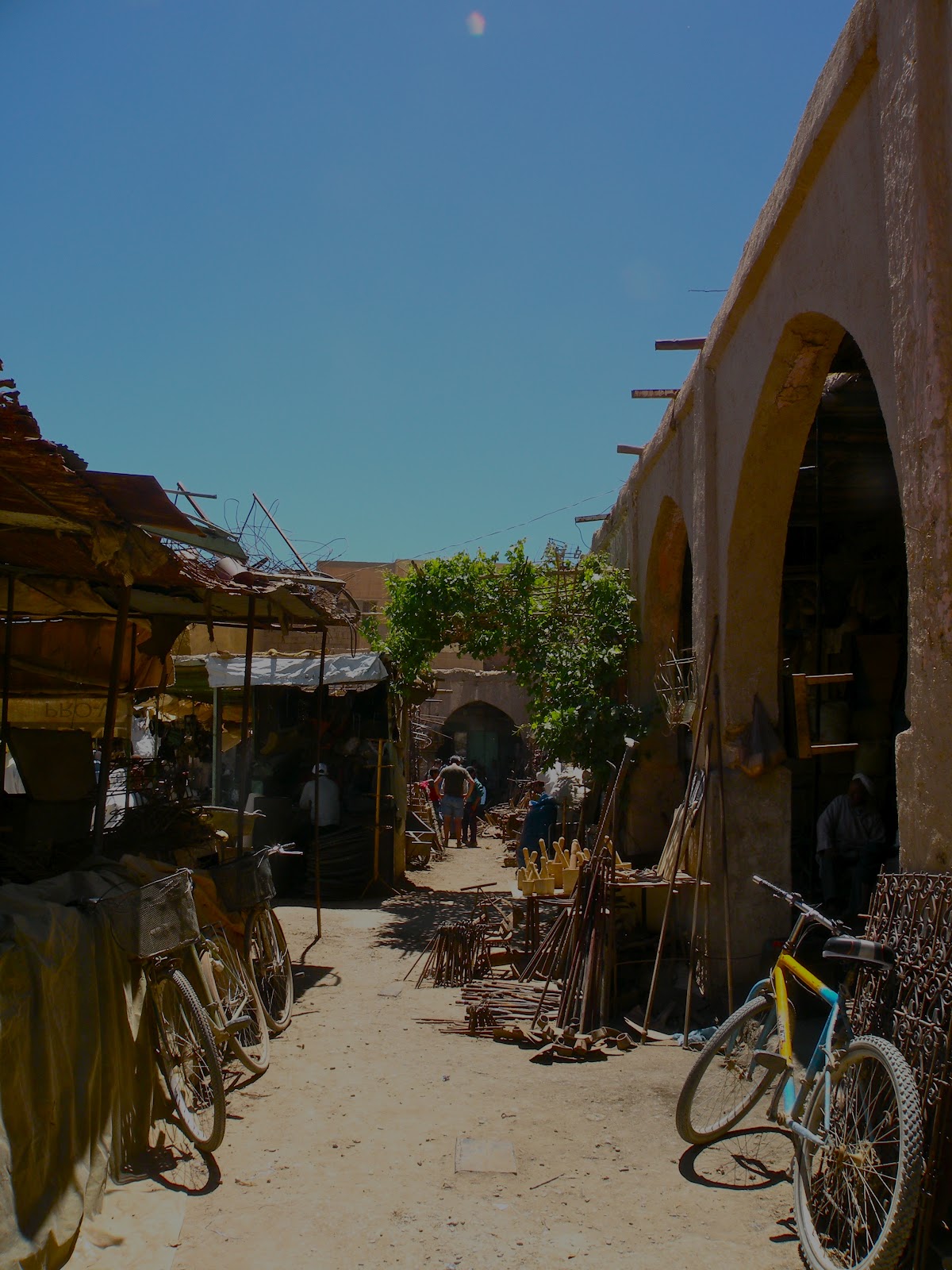
On Sunday morning, we grabbed a grand taxi from the nearby village and headed to the town of Rissani, which has a large bustling souk on Sundays. On the way, we passed the ancient town of Sijilmassa, a site embedded in historical significance. It dates back to the 8th century and was once a major destination of caravans coming from Sub-Saharan Africa to trade gold in exchange for Saharan salt. 


While most of the commodities being sold and traded in the marketplace was familiar to us, the product pictured below was new to us: buckets and baskets made out of recycled tires. 


A view of the center of Rissani from the rooftop café where we had lunch:


In the afternoon, we returned to our hotel in Merzouga eager to explore the sand dunes.


Sand for miles and miles...


Camels waiting patiently in the dunes to take a French family on a sunset camel ride


We decided to hike up one of the largest dunes in Merzouga. Above is a photo from about 3/4 of the way up (35 minute hike)


View from the top! 


Though not fully visible in the photo, just beyond the horizon is a mountain range on the Algerian border.


We ran all the way down. 


When we told our English students that we were heading to the desert for the weekend, they told us that the sand is very good for one's health, and that it is customary to bury yourself in it as a way of healing whatever ails you. If this is true, then we must be in very good health. Even after a thorough showering I am still finding sand on my body. The surreality of our environment made the weekend feel dream like. Maybe it's the sand, or maybe something a little less tangible, but it is undeniable that there is something very therapeutic about being in such a beautiful and remote environment. B'sahah!


Wednesday, April 18, 2012

Casse Croute Cooking


One element that takes a while for travelers to get used to is meal schedules. Every country seems to have its own specific internal clock that lets everyone know when to have breakfast, lunch, dinner, and so on. Morocco is no exception to this rule. I always feel like I'm eating at the wrong time when I'm traveling - whether I'm having dinner in an empty restaurant, expecting breakfast food and only finding places serving lunch, or having my waiter react to my order by asking me, "you want that now?".

It has taken me nearly a year of living here to finally get into the rhythm of Moroccan meal timing. Here is what I have learned:

8-10 am: Breakfast (breads, jams, olive oil, coffee, tea, black olives)
1-3 pm: Lunch (Tagines, couscous, bean soups, or a sandwich/panini if you are on the go)
5-7 ish: "Casse Croute" (a word borrowed from the French that means snack), also known as tea time (similar foods to breakfast, plus cookies or cake if enjoyed with guests or friends)
9-11 ish: Dinner (generally lighter than lunch, maybe leftovers, spaghetti, soups such as harira or semolina, stewed vegetables, fish)
Dessert: fresh fruit, if anything

*this schedule is merely a set of estimates and shouldn't by any means be taken as a unchanging fact*

If you spend anytime in Morocco you will fall in love with the breads that are prepared for Casse Croute. In the mornings and late afternoons you see women rolling out their gas griddles onto the sidewalks in front of cafés and snack shops as they begin to pan fry various types of breads. The smell is intoxicating.


With most types of cooking in Morocco, it is difficult to find any exact recipes. Moroccan women cook with their senses - smell, taste, touch, look. It is a "pinch-full" of this, or a "splash" of that, or "add this until it looks like that" kind of style, which at first can feel impossible to a foreigner who was brought up using measuring cups, scales, and ovens with precise temperature readings. However, if you get over this learning curve and embrace the creativity and trust your instincts (or your teacher's), I promise the end result will be nothing but delicious. 

Beghrir (be-gh-reer)


Beghrir is a light spongy pancake that is usually served drizzled in honey and eaten during casse croute. Many families eat beghrir as a way to break their daily fast during the month of Ramadan because it is easy to eat several without feeling stuffed. I'm not sure how great of an attribute this is...


yields 12-15 pancakes


Ingredients
1T (or spoonful - teaspoon sized and semi-heaping) of sea salt
250 grams of semolina flour (finely ground)


4 packets of Idéal (brand) baking soda (32 grams total)


Warm water


In a blender, combine the salt and the semolina flour and add warm (not hot) water until it makes a batter that resembles that of a thin pancake batter. Blend until mixed well and then add baking soda. Blend until it is mixed through, but don't over do it. 


Using a small non-stick frying pan over medium to high heat. Ladle the batter into a pan so it resembles a pancake. The batter will begin to bubble and then firm up. When this happens, the beghrir is ready! Slide it out of the pan onto a plate, drizzle with honey, and enjoy! 


Melaoui (me-la-wee)


Melaoui is what I'd imagine the spawn of a pancake and fried dough to taste like. Crispy and buttery on the outside with a doughy center, it is sure to please. Moroccans eat it with a wide variety of spreads, such as: honey, Vache qui Rit (spreadable cheese), olive oil, butter, jam, amlou (a spread made out of honey, Argan oil, and honey). I personally enjoy it with honey and a jet black espresso. 


Yields about 12 servings


Ingredients


(approx.) 250 grams of all purpose flour (or however much you want to use) - SIFTED
a pinch of table salt (to taste)
(approx.) 4 grams of baking soda
Warm water


vegetable oil (zeet)
butter or margarine (zebda) - softened or spreadable is best 


Medium ground semolina flour


 In a large mixing bowl, mix your dry ingredients. Gradually add splashes of warm water until the consistency resembles a sticky bread dough. The best way to tell this is by mixing with your hands.


Next, dump the batter onto a clean countertop and begin working the dough by rolling and kneading it. Do this for approximately 3 minutes.


Grease a cookie sheet with vegetable oil. 


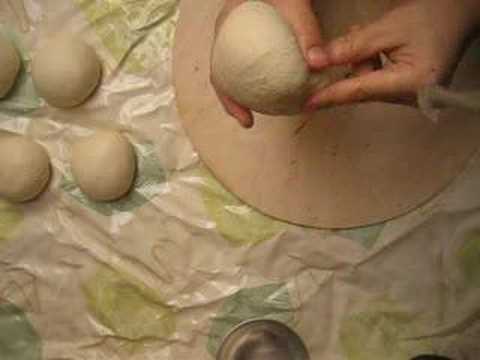
Rub a bit of vegetable oil onto your hands and begin pinching off balls of dough about the size of a small child's fist and placing them on the greased cookie sheet. Once all the balls of dough are on the cookie sheet cover it with saran wrap for about 15 minutes. While you are waiting for the dough to rest, pour about 1/2 a cup of vegetable oil and a few spoonfuls of butter or margarine into a small dish. In another small dish, pour out about 1/2 a cup of semolina flour. 


After 15 minutes, uncover the dough and rub your hands with the oil/butter mixture from the dish. Then, take each ball one by one and press it out until it is flat and thin and (hopefully) circular. Rub a bit of oil/butter onto the dough and sprinkle a little bit of semolina flour into the center. 


Next, imagine an imaginary line running vertically through the center of the dough. Fold the sides of the dough in to the center, rub with oil/butter and sprinkle with semolina flour. Do the same with the top and bottom of the dough. It should look like a square little package. 


Once this has been completed, flatten out each dough "package" until thin and then place it in a cast iron (or whatever you have) skillet over medium-high heat. Once it starts puffing up, flip it over and add a little bit of oil/butter with your fingers. Once both sides are golden brown, your melaoui is finished! 


Note: Because I learned how to make these recipes in a hands on a way (read: my hands were too buttery to document the experience with my camera). The photos in the melaoui recipe were taken from an article on About.com for how to make traditional Melaoui step by step.


b'Ssahahtek! 
(to your health)


Monday, April 16, 2012

A funny thing happened on the way to Marrakech...

This past week was wonderful.

We had visitors from the United States (read: my boyfriend's parents came to Morocco for the first time!) and we had a great week showing them around Rabat and Marrakech. It is always an interesting experience having guests. Not only does it give you an excuse to take time off from work, but it encourages you to see the world around you from a new perspective. Things that you take for granted -nearly getting hit by speeding cars when trying to cross the road, weaving through the old medina streets, living less than ten minutes away from the King's palace, to name a few - all become special things again.

It also gave us a reason to re-visit Marrakech. When I mention Morocco to friends, family, and strangers back at home, one of the most common outbursts I get is, "oh, Marrakech, right?" or "Marrakech Express!". In a nutshell, Marrakech is one of the most well-known aspects about Morocco. Naturally, as a tourist with less than a week to explore the country, it is a high-priority destination. The stories of snake charmers, story tellers, monkeys, and fortune tellers are not hyperbole, but rather reality. The old medina that we stayed in feels more chaotic than our familiar Rabat medina. Not only is it packed with tourists and polyglot shopkeepers haranguing said tourists, but there are also donkeys pushing carts filled with anything from fresh produce, engine parts, or cases of Coca-Cola. Did I mention everyone rides motor bikes? Even women in djellabas and head scarves?

Outside of the congested medina streets are high red clay walls that wrap around the city and seem to glow as the sun sets, setting fire to the palm trees and ducking behind the tall distant mountains that are still capped in snow.


Marrakech is no exception to the rule that Moroccans live in a world of paradox, where you find elements of tradition next to modernity, a desert climate next to snow-capped mountains, an illiterate man who has never left the country can speak multiple languages. It is this juxtaposition of opposites that makes Morocco so culturally rich and expansive. There is no one singular Moroccan experience.

With that being said, I'd like to share a particularly unique experience that happened to us on the train to Marrakech. The train ride between Rabat and Marrakech takes about 4 and a half hours. The first time I took a weekend trip there my friends and I bought 2nd class tickets, without knowing that in second class there is no limit to how many tickets could be sold. Long story short? We ended up standing body-to-body in a sweaty train car for half of the ride before we could find a seat. Ever since then I have learned my lesson. For long train rides I always pay a little more and buy a first class ticket. First class is the only section of trains in Morocco where your ticket corresponds to a specific seat and car number. Especially since we were traveling with guests, we thought that our choice would give us peace of mind. We took an early morning train and within minutes of departing the Rabat Ville station we all began to nod off.

I didn't notice that a few stops into our trip a young woman (about my age, in her 20's) got into our car and sat in the empty seat next to me. About twenty minutes later, my boyfriend nudged my arm to wake me up when he noticed the girl next to me writhe about and then fall to the floor, totally sprawled out between the two rows of chairs facing one another. My first thought was perhaps she was having a seizure, but I quickly realized that this couldn't be the case. Her eyes seemed glazed over and she was moaning loudly and uncontrollably as she tried to rip her shirt off. She seemed really upset and started dry heaving. The only thing we could do was try to wake her up, but nothing seemed to work. Within seconds, she began having what is best described as a severe tantrum. She flailed her legs and arms in all directions with great force while still moaning loudly. So loud, in fact, that by this point we had acquired a bit of an audience outside our car looking on in awe. The next thing I knew she began slurring a single phrase in Arabic over and over. It was difficult to understand exactly what she was saying, but from what I could gather, it was something to the tune of, "he has everything, I am alone." Later, she began reciting what seemed like Quranic verses, "Allahu Akbar" (God is Great), "La ila illa allah wa Muhammad rassoul allah" (There is no God but God and Mohamed is His prophet), and another verse about "Shaytan" (Satan).

An older woman from a neighboring car came in to help us try and restrain her. Without missing a beat, she immediately called her daughter to bring her a bottle of water and her perfume. When I saw how relatively calm she was by this seeming medical anomaly happening before us, I began to piece together my knowledge of Moroccan folkloric culture. I started to wonder if this was what Moroccans call a djinn (spirit) possession. The woman began to spritz the girl's face with water and then sprayed perfume around her face, presumably in attempt to make her come to her senses. Nothing seemed to work. She didn't flinch at the water. She continued to moan and wail the same phrases over and over again. Shortly after, the people in the car took her iphone and started playing a Surah from the Quran off of her iphone's iTunes library and tried to hold it up to her ear. I was pinned to my seat, trying to sort out my own feelings about the event happening in front of my eyes. Should I be scared? Uncomfortable? Intrigued? Excited? All I knew was I wanted to stay calm, alert, and absorb as much of the scene as possible. Within minutes, the conductor of the train came in and started to help move the girl off the floor and lay her down on a row of chairs, helping another man in the car pin down her limbs as she tried to kick them off.

I don't know how much time passed as we sat there watching the scene unfold. After they got her off the floor, she began speaking French and English, but repeating the same lines she had been saying in Arabic. She then started screaming, "Ana Mohamed!" (I am Mohamed!) "Ana min Filastine" (I am from Palestine). A few minutes later she made eye contact with my boyfriend and started to have a conversation with him in English. She was telling him how lucky he was that he doesn't live in Morocco, to which he replied, "But I do. I live in Rabat." Without missing a beat, she said, "You're welcome in my country." She continued, "Do you know who I am? I am Mohamed. I come from Palestine. Do you know Palestine? I am beautiful and therefore no one loves me. I am all alone." It was shortly after this episode that the train conductor suggested that we leave the cabin and he helped us find new seats as the girl slumped back into her hysterical trance-like state.

As our train ride was coming to an end, the same girl, now conscious, found us in our new seats. Accompanied by the train conductor, she sincerely apologized to us for her actions. She appeared incredibly embarrassed and upset. We left it at that.

So, what happened exactly?

Following my gut instinct, I decided to look more into Djinn spirits and their role in Moroccan folk tradition. Djinns are spirits who live in a parallel universe to human kind's. The word "djinn" in Arabic comes from the verb meaning to conceal or to hide, since they are invisible to the human eye. In the Quran it states:

 "Indeed We created man from dried clay of black smooth mud. And We created the Jinn before that from the smokeless flame of fire" 
                                                                (Surah Al-Hijr 15:26-27)


In the Muslim tradition djinoun (plural of djinn) are believed to have the ability to inhabit minds or bodies. If a person does become possessed by a djinn, the name of Allah must be used to expel the spirit from its host. When I looked at a website that detailed the symptoms of djinn possession it became even more peculiar. The girl's behavior matched so many of the characteristics listed - seizure-like movements, talking to oneself, quick to get angry or weep with no apparent cause, erratic behavior and movements, moaning, and groaning. I also spoke to a few Moroccan friends who immediately recognized the behavior I was describing and said that it was most likely an episode of possession.

While I am skeptical of attributing this particular case to spiritual or religious affliction, it was chilling to me just how accurate the descriptions of djinn possession that I read were to what I saw happen before my eyes. Thinking back to Morocco and its paradoxical culture, I couldn't help but be amused by the circumstances: a young girl seems to fall ill by a spiritual possession in the first class car of a train to Marrakech. In her feverish state, she recites ancient scripture in multiple languages. Fellow passengers attempt to calm her down by playing Quranic verses...from her iphone. 


What else could have happened?

I spoke with two Moroccan women who work at the study abroad organization where I work - one is a Darija (Colloquial Moroccan Arabic) professor from Fez and the other is our cleaning lady. When I described the scene to them they first thought it was what they called a Suraa/Sur3,  or a hysterical episode. However, when I told them about her Quranic recitations of "Allahu Akbar" and "La ila illa Allah wa Muhammad rassoul Allah"  they immediately looked at each other with a look of understanding. They explained to me that in their opinion it was most likely the response to a khbar al-mout or death announcement that she received via telephone. 

In reality, who really knows what happened? It definitely is interesting to specultate. This experience has shown me another way in which Morocco walks the line that divides tradition and modernity. In the 21st century many families still hold onto ancient rituals and folklore surrounding spirits, life, and death. For instance, it is common knowledge to  Moroccans that if you whistle inside you are inviting djinn into the home. It is also not a good idea to pour hot water down the drain because that is where the djnoun live and it will upset them. If it truly was a death announcement, why is it that her reaction was so much different than what I would have if I was in her position? Is it a personal difference, or perhaps a greater difference in our cultural upbringing? 

What I witnessed on the train ride presented me with a new challenge: at what point does it no longer make sense to assess an experience through the lens of local culture? Should I take the word of my friends and colleagues who have lived here their whole lives, or should I refer back to my own sociocultural upbringing and attribute what I observed to a fit of extreme psychological hysteria induced by stress or traumatic news? I suppose this is part of the fun in obtaining cross-cultural understanding. 


Sunday, March 25, 2012

Satan leaves first (and other knowledge picked up around the table)

A few things I learned last night over drinks with some Moroccan friends:

1. Social Rules - In Arabic, there is a popular saying where one person asks: "Who leaves the group first?" and everyone answers, "Satan."

This phrase really sheds light on Moroccan social habits. Friendship in Morocco happens quickly, but keeping and cultivating a strong bond between friends is a favorite (and highly prioritized) pass time of Moroccans. Leaving a social situation prematurely can result in severe hshuma (shame) upon you.


2. Couscous Origins - The tradition of Friday couscous came out of necessity. In Morocco, Saturday is the souq, or market, where everyone goes to get their meat, fresh produce, and other goods. The rest of the week there were no new shipments coming into the medinas, which meant that by Friday everyone was trying to use all their leftover produce before the souq the next day. The best way to do this was by making a stew of vegetables and meat. To make it more filling, they also steam semolina grain (couscous) to eat with the dish. In a way you can think of couscous as filling a similar cultural/gastronomical role as paella in Spain or bouillabaise in France.

 I was also told that their is a folk tale about a man who came to Morocco and fell in love with a woman from afar. When he left the country he couldn't stop thinking about her and knew he needed to return to find her and marry her. The man returned to Morocco in search of the woman and didn't eat for days. He finally found her on Friday after days of not eating. He was very weak and requested a "complete" meal, filled with meat, vegetables, and grains, so that he could regain his strength. The result? Couscous.

3. Moroccan Progress in the form of a Feed Lot - Morocco is in the midst of building its first feed lot down south. Up until now, their meat and dairy industry has been kept relatively small with the exception of a few major companies. While it breaks my heart to think that in ten years the meat and dairy industry in Morocco may be very similar to the United States, it shows how development is not a black and white issue. While there are clearly many benefits to progress and development on all levels of society, with it come inevitable sacrifices. Furthermore, can standard butchering practices at feed lots conform to halal requirements?


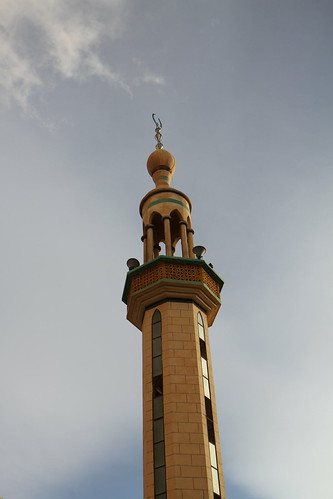
4. Best Kept Secret to Filming in the Middle East - Don't let the traditional gulf-style wardrobe fool you: the new M.I.A. music video, "Bad Girls" was filmed in a desert town in southern Morocco called Ouarzazate; home to Atlas Film Studios. This film studio has been used over the decades as a cheap and safe alternative backdrop for desert and post-apocalyptic films, such as Babel, Star Wars, Body of Lies, and The Green Zone, among countless others. Morocco is also a popular choice for directors whose films are set in the Middle East. How can you tell if a film is actually shot in the Middle East or in Morocco? Look at the minarets. In the Middle East all minarets are cylindrical. In Morocco they are square as a result of the Andalusian influence.

Koutoubia Mosque, Marrakech


Minaret in Syria

Oh, also the trick when they drive the cars on two wheels is no CGI-magic. Apparently it is a relatively popular pass time in the Gulf for guys who want to "soup up" their cars. To my knowledge, Moroccans still prefer the simpler thrill of speeding and parking lot doughnuts.