Tuesday, May 1, 2012

Our Trip to Merzouga


For our last Moroccan adventure before he leaves for home, we decided to go big and head to the Sahara desert. On Friday evening we boarded a train to Meknes (standing room only) and then caught an overnight bus to Merzouga, a small town in the Sahara near the Algerian border. 

We stayed in a small little hotel called Auberge du Sahara, where we were treated somewhere between royalty and family. Everything we did was met with a marhaba, or "you are welcome" from hotel staff.  We arrived during a strong wind storm, which gave us the morning to recuperate from our long journey. When the weather settled down, this was the view we enjoyed from the back patio:


On Sunday morning, we grabbed a grand taxi from the nearby village and headed to the town of Rissani, which has a large bustling souk on Sundays. On the way, we passed the ancient town of Sijilmassa, a site embedded in historical significance. It dates back to the 8th century and was once a major destination of caravans coming from Sub-Saharan Africa to trade gold in exchange for Saharan salt. 


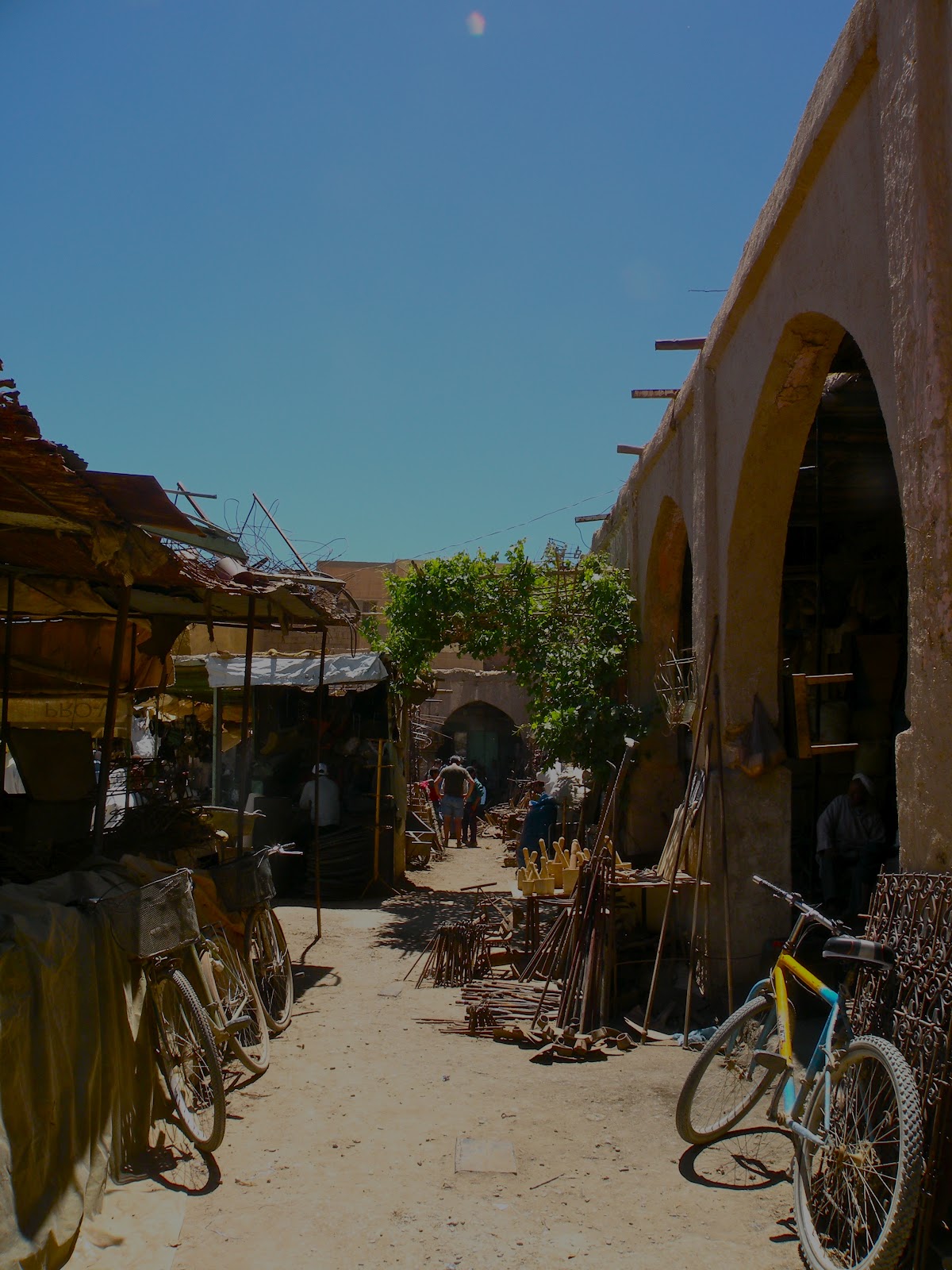
While most of the commodities being sold and traded in the marketplace was familiar to us, the product pictured below was new to us: buckets and baskets made out of recycled tires. 


A view of the center of Rissani from the rooftop café where we had lunch:


In the afternoon, we returned to our hotel in Merzouga eager to explore the sand dunes.


Sand for miles and miles...


Camels waiting patiently in the dunes to take a French family on a sunset camel ride


We decided to hike up one of the largest dunes in Merzouga. Above is a photo from about 3/4 of the way up (35 minute hike)


View from the top! 


Though not fully visible in the photo, just beyond the horizon is a mountain range on the Algerian border.


We ran all the way down. 


When we told our English students that we were heading to the desert for the weekend, they told us that the sand is very good for one's health, and that it is customary to bury yourself in it as a way of healing whatever ails you. If this is true, then we must be in very good health. Even after a thorough showering I am still finding sand on my body. The surreality of our environment made the weekend feel dream like. Maybe it's the sand, or maybe something a little less tangible, but it is undeniable that there is something very therapeutic about being in such a beautiful and remote environment. B'sahah!


Wednesday, April 18, 2012

Casse Croute Cooking


One element that takes a while for travelers to get used to is meal schedules. Every country seems to have its own specific internal clock that lets everyone know when to have breakfast, lunch, dinner, and so on. Morocco is no exception to this rule. I always feel like I'm eating at the wrong time when I'm traveling - whether I'm having dinner in an empty restaurant, expecting breakfast food and only finding places serving lunch, or having my waiter react to my order by asking me, "you want that now?".

It has taken me nearly a year of living here to finally get into the rhythm of Moroccan meal timing. Here is what I have learned:

8-10 am: Breakfast (breads, jams, olive oil, coffee, tea, black olives)
1-3 pm: Lunch (Tagines, couscous, bean soups, or a sandwich/panini if you are on the go)
5-7 ish: "Casse Croute" (a word borrowed from the French that means snack), also known as tea time (similar foods to breakfast, plus cookies or cake if enjoyed with guests or friends)
9-11 ish: Dinner (generally lighter than lunch, maybe leftovers, spaghetti, soups such as harira or semolina, stewed vegetables, fish)
Dessert: fresh fruit, if anything

*this schedule is merely a set of estimates and shouldn't by any means be taken as a unchanging fact*

If you spend anytime in Morocco you will fall in love with the breads that are prepared for Casse Croute. In the mornings and late afternoons you see women rolling out their gas griddles onto the sidewalks in front of cafés and snack shops as they begin to pan fry various types of breads. The smell is intoxicating.


With most types of cooking in Morocco, it is difficult to find any exact recipes. Moroccan women cook with their senses - smell, taste, touch, look. It is a "pinch-full" of this, or a "splash" of that, or "add this until it looks like that" kind of style, which at first can feel impossible to a foreigner who was brought up using measuring cups, scales, and ovens with precise temperature readings. However, if you get over this learning curve and embrace the creativity and trust your instincts (or your teacher's), I promise the end result will be nothing but delicious. 

Beghrir (be-gh-reer)


Beghrir is a light spongy pancake that is usually served drizzled in honey and eaten during casse croute. Many families eat beghrir as a way to break their daily fast during the month of Ramadan because it is easy to eat several without feeling stuffed. I'm not sure how great of an attribute this is...


yields 12-15 pancakes


Ingredients
1T (or spoonful - teaspoon sized and semi-heaping) of sea salt
250 grams of semolina flour (finely ground)


4 packets of Idéal (brand) baking soda (32 grams total)


Warm water


In a blender, combine the salt and the semolina flour and add warm (not hot) water until it makes a batter that resembles that of a thin pancake batter. Blend until mixed well and then add baking soda. Blend until it is mixed through, but don't over do it. 


Using a small non-stick frying pan over medium to high heat. Ladle the batter into a pan so it resembles a pancake. The batter will begin to bubble and then firm up. When this happens, the beghrir is ready! Slide it out of the pan onto a plate, drizzle with honey, and enjoy! 


Melaoui (me-la-wee)


Melaoui is what I'd imagine the spawn of a pancake and fried dough to taste like. Crispy and buttery on the outside with a doughy center, it is sure to please. Moroccans eat it with a wide variety of spreads, such as: honey, Vache qui Rit (spreadable cheese), olive oil, butter, jam, amlou (a spread made out of honey, Argan oil, and honey). I personally enjoy it with honey and a jet black espresso. 


Yields about 12 servings


Ingredients


(approx.) 250 grams of all purpose flour (or however much you want to use) - SIFTED
a pinch of table salt (to taste)
(approx.) 4 grams of baking soda
Warm water


vegetable oil (zeet)
butter or margarine (zebda) - softened or spreadable is best 


Medium ground semolina flour


 In a large mixing bowl, mix your dry ingredients. Gradually add splashes of warm water until the consistency resembles a sticky bread dough. The best way to tell this is by mixing with your hands.


Next, dump the batter onto a clean countertop and begin working the dough by rolling and kneading it. Do this for approximately 3 minutes.


Grease a cookie sheet with vegetable oil. 


Rub a bit of vegetable oil onto your hands and begin pinching off balls of dough about the size of a small child's fist and placing them on the greased cookie sheet. Once all the balls of dough are on the cookie sheet cover it with saran wrap for about 15 minutes. While you are waiting for the dough to rest, pour about 1/2 a cup of vegetable oil and a few spoonfuls of butter or margarine into a small dish. In another small dish, pour out about 1/2 a cup of semolina flour. 


After 15 minutes, uncover the dough and rub your hands with the oil/butter mixture from the dish. Then, take each ball one by one and press it out until it is flat and thin and (hopefully) circular. Rub a bit of oil/butter onto the dough and sprinkle a little bit of semolina flour into the center. 


Next, imagine an imaginary line running vertically through the center of the dough. Fold the sides of the dough in to the center, rub with oil/butter and sprinkle with semolina flour. Do the same with the top and bottom of the dough. It should look like a square little package. 


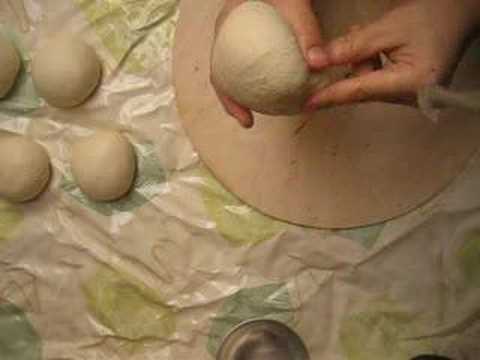
Once this has been completed, flatten out each dough "package" until thin and then place it in a cast iron (or whatever you have) skillet over medium-high heat. Once it starts puffing up, flip it over and add a little bit of oil/butter with your fingers. Once both sides are golden brown, your melaoui is finished! 


Note: Because I learned how to make these recipes in a hands on a way (read: my hands were too buttery to document the experience with my camera). The photos in the melaoui recipe were taken from an article on About.com for how to make traditional Melaoui step by step.


b'Ssahahtek! 
(to your health)


Monday, April 16, 2012

A funny thing happened on the way to Marrakech...

This past week was wonderful.

We had visitors from the United States (read: my boyfriend's parents came to Morocco for the first time!) and we had a great week showing them around Rabat and Marrakech. It is always an interesting experience having guests. Not only does it give you an excuse to take time off from work, but it encourages you to see the world around you from a new perspective. Things that you take for granted -nearly getting hit by speeding cars when trying to cross the road, weaving through the old medina streets, living less than ten minutes away from the King's palace, to name a few - all become special things again.

It also gave us a reason to re-visit Marrakech. When I mention Morocco to friends, family, and strangers back at home, one of the most common outbursts I get is, "oh, Marrakech, right?" or "Marrakech Express!". In a nutshell, Marrakech is one of the most well-known aspects about Morocco. Naturally, as a tourist with less than a week to explore the country, it is a high-priority destination. The stories of snake charmers, story tellers, monkeys, and fortune tellers are not hyperbole, but rather reality. The old medina that we stayed in feels more chaotic than our familiar Rabat medina. Not only is it packed with tourists and polyglot shopkeepers haranguing said tourists, but there are also donkeys pushing carts filled with anything from fresh produce, engine parts, or cases of Coca-Cola. Did I mention everyone rides motor bikes? Even women in djellabas and head scarves?

Outside of the congested medina streets are high red clay walls that wrap around the city and seem to glow as the sun sets, setting fire to the palm trees and ducking behind the tall distant mountains that are still capped in snow.


Marrakech is no exception to the rule that Moroccans live in a world of paradox, where you find elements of tradition next to modernity, a desert climate next to snow-capped mountains, an illiterate man who has never left the country can speak multiple languages. It is this juxtaposition of opposites that makes Morocco so culturally rich and expansive. There is no one singular Moroccan experience.

With that being said, I'd like to share a particularly unique experience that happened to us on the train to Marrakech. The train ride between Rabat and Marrakech takes about 4 and a half hours. The first time I took a weekend trip there my friends and I bought 2nd class tickets, without knowing that in second class there is no limit to how many tickets could be sold. Long story short? We ended up standing body-to-body in a sweaty train car for half of the ride before we could find a seat. Ever since then I have learned my lesson. For long train rides I always pay a little more and buy a first class ticket. First class is the only section of trains in Morocco where your ticket corresponds to a specific seat and car number. Especially since we were traveling with guests, we thought that our choice would give us peace of mind. We took an early morning train and within minutes of departing the Rabat Ville station we all began to nod off.

I didn't notice that a few stops into our trip a young woman (about my age, in her 20's) got into our car and sat in the empty seat next to me. About twenty minutes later, my boyfriend nudged my arm to wake me up when he noticed the girl next to me writhe about and then fall to the floor, totally sprawled out between the two rows of chairs facing one another. My first thought was perhaps she was having a seizure, but I quickly realized that this couldn't be the case. Her eyes seemed glazed over and she was moaning loudly and uncontrollably as she tried to rip her shirt off. She seemed really upset and started dry heaving. The only thing we could do was try to wake her up, but nothing seemed to work. Within seconds, she began having what is best described as a severe tantrum. She flailed her legs and arms in all directions with great force while still moaning loudly. So loud, in fact, that by this point we had acquired a bit of an audience outside our car looking on in awe. The next thing I knew she began slurring a single phrase in Arabic over and over. It was difficult to understand exactly what she was saying, but from what I could gather, it was something to the tune of, "he has everything, I am alone." Later, she began reciting what seemed like Quranic verses, "Allahu Akbar" (God is Great), "La ila illa allah wa Muhammad rassoul allah" (There is no God but God and Mohamed is His prophet), and another verse about "Shaytan" (Satan).

An older woman from a neighboring car came in to help us try and restrain her. Without missing a beat, she immediately called her daughter to bring her a bottle of water and her perfume. When I saw how relatively calm she was by this seeming medical anomaly happening before us, I began to piece together my knowledge of Moroccan folkloric culture. I started to wonder if this was what Moroccans call a djinn (spirit) possession. The woman began to spritz the girl's face with water and then sprayed perfume around her face, presumably in attempt to make her come to her senses. Nothing seemed to work. She didn't flinch at the water. She continued to moan and wail the same phrases over and over again. Shortly after, the people in the car took her iphone and started playing a Surah from the Quran off of her iphone's iTunes library and tried to hold it up to her ear. I was pinned to my seat, trying to sort out my own feelings about the event happening in front of my eyes. Should I be scared? Uncomfortable? Intrigued? Excited? All I knew was I wanted to stay calm, alert, and absorb as much of the scene as possible. Within minutes, the conductor of the train came in and started to help move the girl off the floor and lay her down on a row of chairs, helping another man in the car pin down her limbs as she tried to kick them off.

I don't know how much time passed as we sat there watching the scene unfold. After they got her off the floor, she began speaking French and English, but repeating the same lines she had been saying in Arabic. She then started screaming, "Ana Mohamed!" (I am Mohamed!) "Ana min Filastine" (I am from Palestine). A few minutes later she made eye contact with my boyfriend and started to have a conversation with him in English. She was telling him how lucky he was that he doesn't live in Morocco, to which he replied, "But I do. I live in Rabat." Without missing a beat, she said, "You're welcome in my country." She continued, "Do you know who I am? I am Mohamed. I come from Palestine. Do you know Palestine? I am beautiful and therefore no one loves me. I am all alone." It was shortly after this episode that the train conductor suggested that we leave the cabin and he helped us find new seats as the girl slumped back into her hysterical trance-like state.

As our train ride was coming to an end, the same girl, now conscious, found us in our new seats. Accompanied by the train conductor, she sincerely apologized to us for her actions. She appeared incredibly embarrassed and upset. We left it at that.

So, what happened exactly?

Following my gut instinct, I decided to look more into Djinn spirits and their role in Moroccan folk tradition. Djinns are spirits who live in a parallel universe to human kind's. The word "djinn" in Arabic comes from the verb meaning to conceal or to hide, since they are invisible to the human eye. In the Quran it states:

 "Indeed We created man from dried clay of black smooth mud. And We created the Jinn before that from the smokeless flame of fire" 
                                                                (Surah Al-Hijr 15:26-27)


In the Muslim tradition djinoun (plural of djinn) are believed to have the ability to inhabit minds or bodies. If a person does become possessed by a djinn, the name of Allah must be used to expel the spirit from its host. When I looked at a website that detailed the symptoms of djinn possession it became even more peculiar. The girl's behavior matched so many of the characteristics listed - seizure-like movements, talking to oneself, quick to get angry or weep with no apparent cause, erratic behavior and movements, moaning, and groaning. I also spoke to a few Moroccan friends who immediately recognized the behavior I was describing and said that it was most likely an episode of possession.

While I am skeptical of attributing this particular case to spiritual or religious affliction, it was chilling to me just how accurate the descriptions of djinn possession that I read were to what I saw happen before my eyes. Thinking back to Morocco and its paradoxical culture, I couldn't help but be amused by the circumstances: a young girl seems to fall ill by a spiritual possession in the first class car of a train to Marrakech. In her feverish state, she recites ancient scripture in multiple languages. Fellow passengers attempt to calm her down by playing Quranic verses...from her iphone. 


What else could have happened?

I spoke with two Moroccan women who work at the study abroad organization where I work - one is a Darija (Colloquial Moroccan Arabic) professor from Fez and the other is our cleaning lady. When I described the scene to them they first thought it was what they called a Suraa/Sur3,  or a hysterical episode. However, when I told them about her Quranic recitations of "Allahu Akbar" and "La ila illa Allah wa Muhammad rassoul Allah"  they immediately looked at each other with a look of understanding. They explained to me that in their opinion it was most likely the response to a khbar al-mout or death announcement that she received via telephone. 

In reality, who really knows what happened? It definitely is interesting to specultate. This experience has shown me another way in which Morocco walks the line that divides tradition and modernity. In the 21st century many families still hold onto ancient rituals and folklore surrounding spirits, life, and death. For instance, it is common knowledge to  Moroccans that if you whistle inside you are inviting djinn into the home. It is also not a good idea to pour hot water down the drain because that is where the djnoun live and it will upset them. If it truly was a death announcement, why is it that her reaction was so much different than what I would have if I was in her position? Is it a personal difference, or perhaps a greater difference in our cultural upbringing? 

What I witnessed on the train ride presented me with a new challenge: at what point does it no longer make sense to assess an experience through the lens of local culture? Should I take the word of my friends and colleagues who have lived here their whole lives, or should I refer back to my own sociocultural upbringing and attribute what I observed to a fit of extreme psychological hysteria induced by stress or traumatic news? I suppose this is part of the fun in obtaining cross-cultural understanding. 


Sunday, March 25, 2012

Satan leaves first (and other knowledge picked up around the table)

A few things I learned last night over drinks with some Moroccan friends:

1. Social Rules - In Arabic, there is a popular saying where one person asks: "Who leaves the group first?" and everyone answers, "Satan."

This phrase really sheds light on Moroccan social habits. Friendship in Morocco happens quickly, but keeping and cultivating a strong bond between friends is a favorite (and highly prioritized) pass time of Moroccans. Leaving a social situation prematurely can result in severe hshuma (shame) upon you.


2. Couscous Origins - The tradition of Friday couscous came out of necessity. In Morocco, Saturday is the souq, or market, where everyone goes to get their meat, fresh produce, and other goods. The rest of the week there were no new shipments coming into the medinas, which meant that by Friday everyone was trying to use all their leftover produce before the souq the next day. The best way to do this was by making a stew of vegetables and meat. To make it more filling, they also steam semolina grain (couscous) to eat with the dish. In a way you can think of couscous as filling a similar cultural/gastronomical role as paella in Spain or bouillabaise in France.

 I was also told that their is a folk tale about a man who came to Morocco and fell in love with a woman from afar. When he left the country he couldn't stop thinking about her and knew he needed to return to find her and marry her. The man returned to Morocco in search of the woman and didn't eat for days. He finally found her on Friday after days of not eating. He was very weak and requested a "complete" meal, filled with meat, vegetables, and grains, so that he could regain his strength. The result? Couscous.

3. Moroccan Progress in the form of a Feed Lot - Morocco is in the midst of building its first feed lot down south. Up until now, their meat and dairy industry has been kept relatively small with the exception of a few major companies. While it breaks my heart to think that in ten years the meat and dairy industry in Morocco may be very similar to the United States, it shows how development is not a black and white issue. While there are clearly many benefits to progress and development on all levels of society, with it come inevitable sacrifices. Furthermore, can standard butchering practices at feed lots conform to halal requirements?


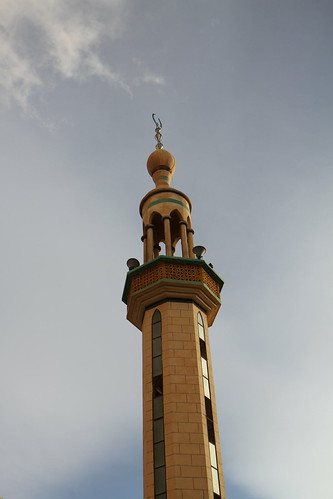
4. Best Kept Secret to Filming in the Middle East - Don't let the traditional gulf-style wardrobe fool you: the new M.I.A. music video, "Bad Girls" was filmed in a desert town in southern Morocco called Ouarzazate; home to Atlas Film Studios. This film studio has been used over the decades as a cheap and safe alternative backdrop for desert and post-apocalyptic films, such as Babel, Star Wars, Body of Lies, and The Green Zone, among countless others. Morocco is also a popular choice for directors whose films are set in the Middle East. How can you tell if a film is actually shot in the Middle East or in Morocco? Look at the minarets. In the Middle East all minarets are cylindrical. In Morocco they are square as a result of the Andalusian influence.

Koutoubia Mosque, Marrakech


Minaret in Syria

Oh, also the trick when they drive the cars on two wheels is no CGI-magic. Apparently it is a relatively popular pass time in the Gulf for guys who want to "soup up" their cars. To my knowledge, Moroccans still prefer the simpler thrill of speeding and parking lot doughnuts. 


Saturday, March 24, 2012

Parliamentary Assembly of the Euro-Mediterranean Union and "Le Maroc qui Bouge"

This morning as I was jogging down Boulevard Mohammed V, I was surprised to see a row stretching several blocks of tourist vans and buses outside of Parliament. Upon the windshield of each car was an official looking piece of paper that said that it was the "8ième édition de l'Assemblée Parlementaire de l'Union Euro-Méditerranée" (8th annual Parliamentary Assembly for the Euro-Mediterranean Union). The assembly, which is having conferences today and tomorrow in Rabat, will be discussing ways in which the European Union and North Africa can work together to improve overall economic and sociopolitical stability in the region as well as with their global allies.  More specifically, they will be talking about ways that parliamentary deputies can support their colleagues whose home countries are undergoing a democratic transition as a result of the Arab Spring. Another major talking point will be about the role that North African economies have in reviving economic growth in the European Union. With the most recent commercial agreement signed between Morocco and and the European Union earlier this year, the EU believes that the key to ensuring a bright future in Europe is by improving their relationships with their neighbors on the other side of the Mediterranean.


Since arriving in Morocco last August, I have noticed an undeniable shift of perspective - whereas in previous decades it had always been North Africa looking for cues and guidance from their colonial patriarchs like France, Spain, and Italy, the tables have now been turned. With the European Union struggling to stay afloat amidst its severe economic crisis as sociopolitical morale hits an all-time low, it is time for the once "top-dogs" to look to their developing southern neighbors for guidance and support. In January of this year, Stephan Füle, European Commissioner for Enlargement and European Neighbourhood Policy, visited Morocco. After his visit, he concluded that the country was going in the right direction and was very pleased with its reform developments made so far. Morocco is one of the fastest growing developing countries in the world, and it is no secret that there is serious consideration on both sides to make it one of the first "Arab" countries to join the European Union.


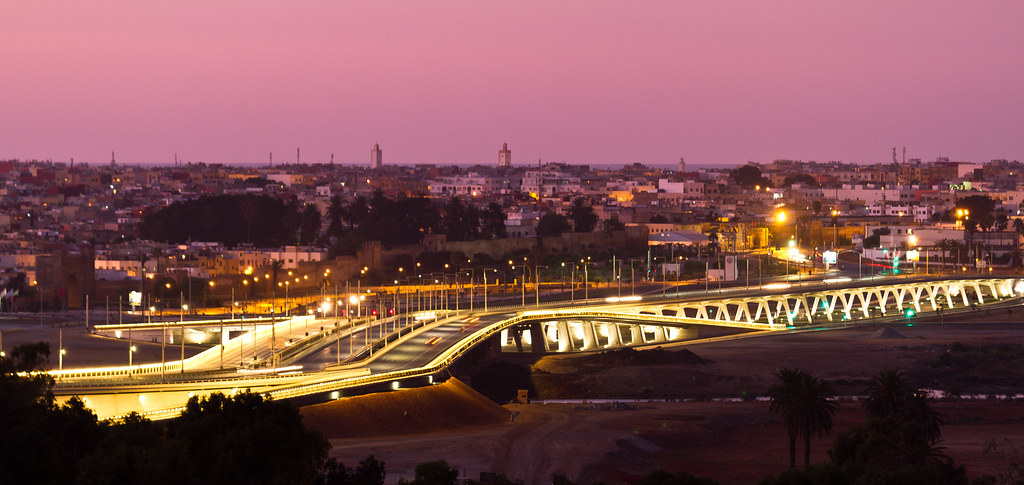
However, with anything growing at the speed that Morocco is, growing pains are inevitable. In the last two years a beautiful new bridge was built to connect Rabat and Salé, its neighbor across the river. A tramway was built (with intention to further expand its route in the near future) in Rabat was a safe and efficient way for commuters and students to get around the city. Morocco Mall in Casablanca opened earlier this year and is the first world-class mall in Africa (It also has two Starbucks Coffees and an aquarium). A high-speed TGV-style train line opened between Casablanca and Tangiers. Every time I revisit cities across the country I am immediately struck by how much it has developed since last time I was there - roads are wider, new luxury hotels and condominiums are built, new glossy car models fill the downtown road systems. Moroccan development is moving at a high velocity and it shows no signs of slowing down.


Even though the major cities are receiving serious makeovers, it only takes a train or bus ride to remember that Moroccan progress is by no means all-encompassing. On the train ride between Rabat and Tangiers for instance you pass mostly through farmlands and small villages with tin-roofed clay houses and sheep scattered about in the fields. The closest taste these communities have to the development witnessed in the major cities is through their satellite televisions. As the sun was going down, we passed by a small town about 30 minutes outside of Asilah where it seemed like the entire town was sitting along the hillside waiting for the train. We heard faint cheering and saw them all waving to us as we sped past. It was a beautiful sight. Despite their remote positioning, the villagers recognize the train as a symbol of progress and hope for the country. Everyday, they watch the train come and go along the tracks carrying families, businessmen and women, and tourists from city to city. Even though they aren't passengers aboard, the train helps them stay connected to "Le Maroc qui bouge" (Moving Morocco).


With Morocco's impeccable geopolitics, and social, political, and economic stability, it is no surprise that Morocco is becoming an important regional player. While many other countries in the MENA region continue to be engulfed in sociopolitical upheaval and Europe in the midst of an economic downfall, Morocco is rising to the occasion as a beacon of hope in the darkness. I just hope that as Morocco continues to develop and become increasingly involved in European and Western politics that it doesn't leave behind a part of itself in the process.

Thursday, March 22, 2012

Tarifa: Seeing Africa from a different perspective

After a while, it doesn't matter where you live - routine sets in and the "honeymoon" feeling wears off. The cultural, environmental, and linguistic differences that were once new and special become normalized and fade into a soft indecipherable blur. I sleep through the 5 am call to prayer and forget which language I had conversations in. I find myself sometimes caught off guard when I am walking down the street and realize that the oak-lined sidewalks of my childhood have been replaced by tall looming palm trees. I never thought I'd have to remind myself that I am living in North Africa, but le voilà.

An easy way that we have learned to keep things "fresh" has been to travel. Unfortunately, it prevents a bit of a catch-22: to travel, you need money. To have money, you need a job. When you have a job, it is difficult to get time off to travel, which leads to the boredom created by routine, and by proxy, a desire to travel.

We have been making an effort to travel more frequently this Spring. It certainly helps that a condition of our visas is that we must leave the country every 90 days to renew them. Last weekend we decided to go to Tarifa, Spain. We chose Tarifa because of its proximity to the Moroccan coast. On a clear day from the beach in Tangiers you can sometimes see the coastline in Tarifa. On Friday morning we packed up a few things, took the 4 hour train to Tangiers, and then hopped on a ferry. We arrived in Tarifa around 11 pm on Friday. The gates to the port lead you right into the cobble-stoned roads of the old "medina" city. Feeling slightly off-kilter from the various forms of transportation and fatigue, I felt like we were entering an alternate-reality version of Morocco. The narrow streets, white washed walls, and painted doors seemed all too familiar. There were two major differences, however, that reminded me we had crossed the border: Catholic churches and rows and rows of bars. The weather was very mild and on our way to find our hostel we passed groups of locals and tourists mingling around outdoor tables beside pubs, smoking cigarettes, and petting dogs. Even though we felt exhausted from a day of traveling, we were pleased by our timing, because11 pm is just about the time that Spaniards seem to wake up from their afternoon siestas and begin to go out.  Below is a photo of our welcome-to-Tarifa mojitos, with mint and raw cane sugar muddled right in front of us:


The following day we spent at the beaches. Tarifa is known for its strong winds and many tourists come for the kite and wind surfing. The coastline was freckled with different colored kites and sails. We began by walking along the beach on the Atlantic Ocean (where we saw a presumably Arab female pop singer filming a music video) and then crossed over the boardwalk onto the beach on the Mediterranean Sea. Sitting on the soft warm sand amongst Spanish families, international tourists, and nude sunbathers, I was stunned by the view: across the sparkling ocean was the large dark green mountainous terrain of North Africa. We met an American woman who moved to Spain 8 years ago and has started a family in Tarifa where she opened the first English school in the city. When talking about where we were coming from, she admitted that she didn't know anything about Morocco, let alone Rabat, the city where we live. It was an odd feeling to be sitting on the beach in Spain facing Morocco and talking to a fellow American woman who spent almost a decade on the opposite side of the Mediterranean without knowing anything about the neighboring country. She was fascinated when we told her about how architecturally similar Andalucia and Morocco are because of their long complicated history. Looking up past the beach the coast of Tarifa is lined with ancient fortress ruins that are almost mirror images of those found along the Moroccan coastlines. How is it that two countries with such shared history and culture can be so cognitively disconnected?


In any case, spending the weekend in Tarifa not only helped me recharge my batteries but it also helped me reconnect where I am, what I'm doing, where I'm going, and how I'm feeling. My current global positioning is Morocco. Instead of making comparisons between Spain and the United States, I am finding commonalities between Spain and my present home turf of Morocco. Walking through the winding streets of the old Tarifa "medina" and noticing street names with Arabic cognates or stumbling upon a restaurant or boutique that markets the Moroccan or African aesthetic exoticism really helped remind me how lucky I am to be able to observe and appreciate the cultural similarities that Morocco and Spain share because of my understanding of how historically these two countries' stories weave together.


The Spaniard lifestyle is one that I can certainly get behind. Their day starts around  ten, morning coffee can be replaced with beer, and after a leisurely afternoon milling around cafés and a long lunch, it is customary to have a siesta to recharge before a long evening out on the town. Saturday afternoon we were wandering around the old city of Tarifa and heard what sounded like a crowd of people singing, laughing, and banging on drums. We followed the sound into an open neighborhood square lined with taverns opening onto the cobblestoned courtyard. Parents were sitting around outdoor tables having a drink while their children ran around together, performed on a small stage, sang songs, and played musical instruments strewn about. It is scenes like this that remind me of what I love so much about Spanish family culture. Instead of treating drinking and adult socializing as an event that must be kept separate and out of reach of the children, parents take their kids out with them as a way for the family to spend time together. It also gives children positive examples of moderate and responsible drinking.


On Sunday morning we woke up to the sound of church bells ringing outside our window. After a vegan brunch at the Tarifa Eco Center (Tarifa has several vegetarian/vegan cafés, if you can believe that!), we took a leisurely stroll around the city, had a beer, and enjoyed the sunshine. We returned to Tangier by ferry on Sunday afternoon with sand in our hair and a fresh batch of freckles.


Thursday, March 15, 2012

International Women's Day in Rabat

First of all, happy belated International Women's Day! 


International Women's Day, which falls on March 8th, is a much larger holiday in Morocco than in the United States. On March 8th, all the female professors at the office walked about with huge smiles and a bounce in their step. They patted one another on the back and wished one another a "happy women's day". The male professors were also getting into the holiday spirit - wishing all the women at the office a happy day. After her class, the Gender Studies professor  came up to me to wish me a "happy women's day" and struck up conversation. I told her that I was amazed by how widely recognized the holiday was in Rabat, and all of Morocco in general. In the United States International Women's Day is barely celebrated. While surprised by my statement, she suggested that perhaps it was because the United States had already achieved gender equality, and therefore it wasn't as important for them to honor a specific day in honor of women's rights. Although comparatively, it is no question that American women enjoy far more freedoms and much greater gender equality than Moroccan women, I still don't think it's a valid excuse for disregarding the holiday. Shouldn't countries like the United States acknowledge the holiday as a way of setting a positive example for other countries to do the same? 

This semester I have decided to audit the Intensive Advanced Modern Standard Arabic class at the study abroad program. While I have technically already surpassed the curriculum, it is a great opportunity to continue practicing, learning, and refreshing my mind of all the complicated grammar rules. In honor of International Women's Day, my Arabic professor requested that for homework we each go out and purchase an Arabic newspaper, find an article about March 8th, read it, and then present a summary to the class the next day. At first, I thought that the assignment was a bit presumptuous. I wondered if it was safe to assume that each newspaper would include articles with enough content on the holiday for it to be worth using? 

After class that day, I went out and bought As-Sabah ("The Morning" newspaper. As I flipped through the pages, I was amazed to find that there was an entire section of the paper dedicated to articles about International Women's Day, events happening in honor of the holiday happening throughout the country, local and international women's rights news, and editorials about how people feel about the holiday. For homework, I read an article where I learned about the source of International Women's Day, which dates back to the Bread and Roses Strike, which, according to the article, happened in 1912 in New York City.  I did a little research of my own and learned that the Bread and Roses Strike was a women-led demonstration that actually happened in the textile mills in Lawrence, Massachusetts and female mill workers took to the streets to demand improved labor rights for women and children. The article spoke about the Bread and Roses Strike as the first important step in the international women's rights movement. It continued by discussing women's role in the ongoing protests and uprisings happening throughout the Middle East and North Africa, stressing especially the fact that one should not think that Muslim women are absent from this discourse. I found the article to be emotionally charged, fairly informative, and inspiring. It makes me wonder what the Boston Globe looked like on March 8th. 

Another exciting element about having this assignment for my Arabic class was that it forced me to buy a newspaper, sit down, and read it. At first glance, Arabic language newspapers look especially daunting. The small print is so and the pages packed with information and articles would make any non-native Arabic speaker feel slightly intimidated. However, after taking a deep breath and diving in, I was pleasantly surprised by how well I could understand the article at first glance, without assistance from a dictionary. It is small daily achievements like this that remind me that although it may not feel like it, everyday that I step outside my door and integrate myself into Moroccan society, I am learning and growing because of it. Some days a small realization like this is all I need to feel like I'm headed down the right path. 

(It also didn't hurt that on March 8th we went out to dinner and upon receiving our menus, the waiter presented me with a single white tulip wrapped delicately in cellophane and tied with a red ribbon in honor of the holiday.)